
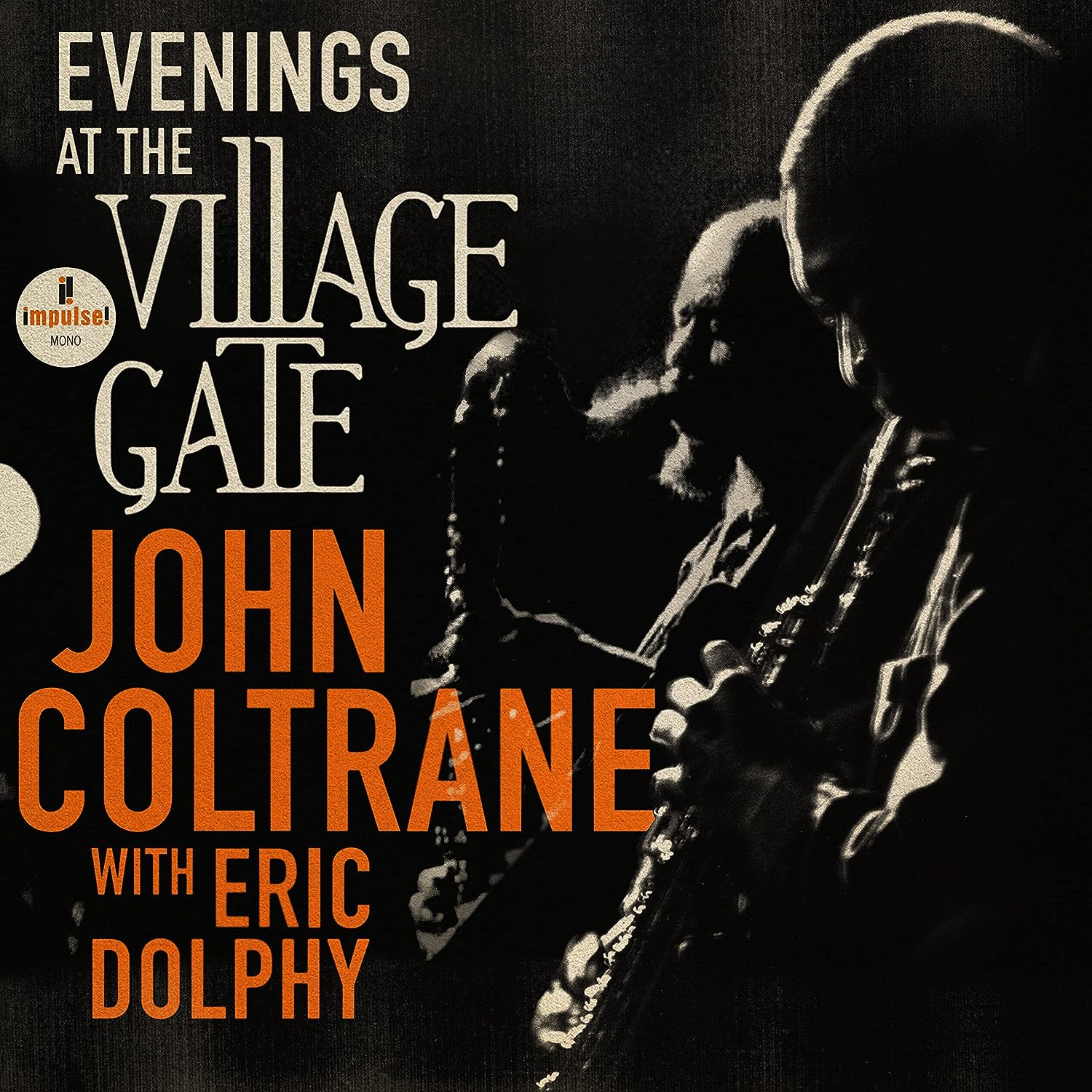
Evenings at the Village Gate: John Coltrane With Eric Dolphy
John Coltrane
2023
Impulse Records
Call this document the Book of Coltrane III, recorded in the summer of 1961, just predating his quintet’s now-iconic Live at the Village Vanguard releases. This means we are treated to the stellar nebula of Coltrane’s new genesis — a revelation, if you asked me to keep it biblical. Trane ain’t Jesus, but check the media zeitgeist of that period and you’ll see that he — along with Dolphy, the creatively spiritual twin — were forsaken prophets; a publicly branded anti-jazz duo intent on destroying the swing faith many still believed in. The liner notes strongly hinted at this rejection or oversight. Even a photojournalist present for the shows talked about watching a sparsely populated nightclub while Coltrane’s quintet played. Reminds me of today’s folk who preached about how they loved to hear Dr. Martin Luther King, Jr. speak — but documented accounts show how many folks never loved him. Art Davis, Elvin Jones, McCoy Tyner, and Reggie Workman helped to keep the squad in its right spiritual place. A must for my ears. Funny how gold like this was found in the New York Public Library by a Bob Dylan archivist. Then again …

Bark Out Thunder Roar Out Lightning
Chief Adjuah
2023
Ropeadope
Is he an ex-Jazz musician? “In transition” may be a better status read. The artist formerly known as Christian Scott dropped a set of two cultural planes intersecting to paint a continuum of shared struggle and expression, summoning the astral deities across subjugated populations with Blues as a mothership — depending on the tune you hear.
Obvious euphonics aside, my dome replaces the first word of Chief Xian aTunde Adjuah’s “stretch music” convention with “connect” because, beyond Adjuah’s description of “attempting to stretch—not replace—Jazz’s rhythmic, melodic and harmonic conventions to encompass as many musical forms/languages/cultures as we can”, his album illustrates commonalities between musical styles, and hips our ears to new understandings as a benefit. The Wassoulou phrasings bleed into masking Indian chants while each track underscored why some schools in the Western world want to ban certain history books. The Maroon-New-Orleans-African cultural blend is further enabled by Adjuah’s instrument inventions and an ensemble that completely gets how The World is a Ghetto. The album presents further evidence of acoustic music’s power.

 mentalunrest.com